

Key takeaways
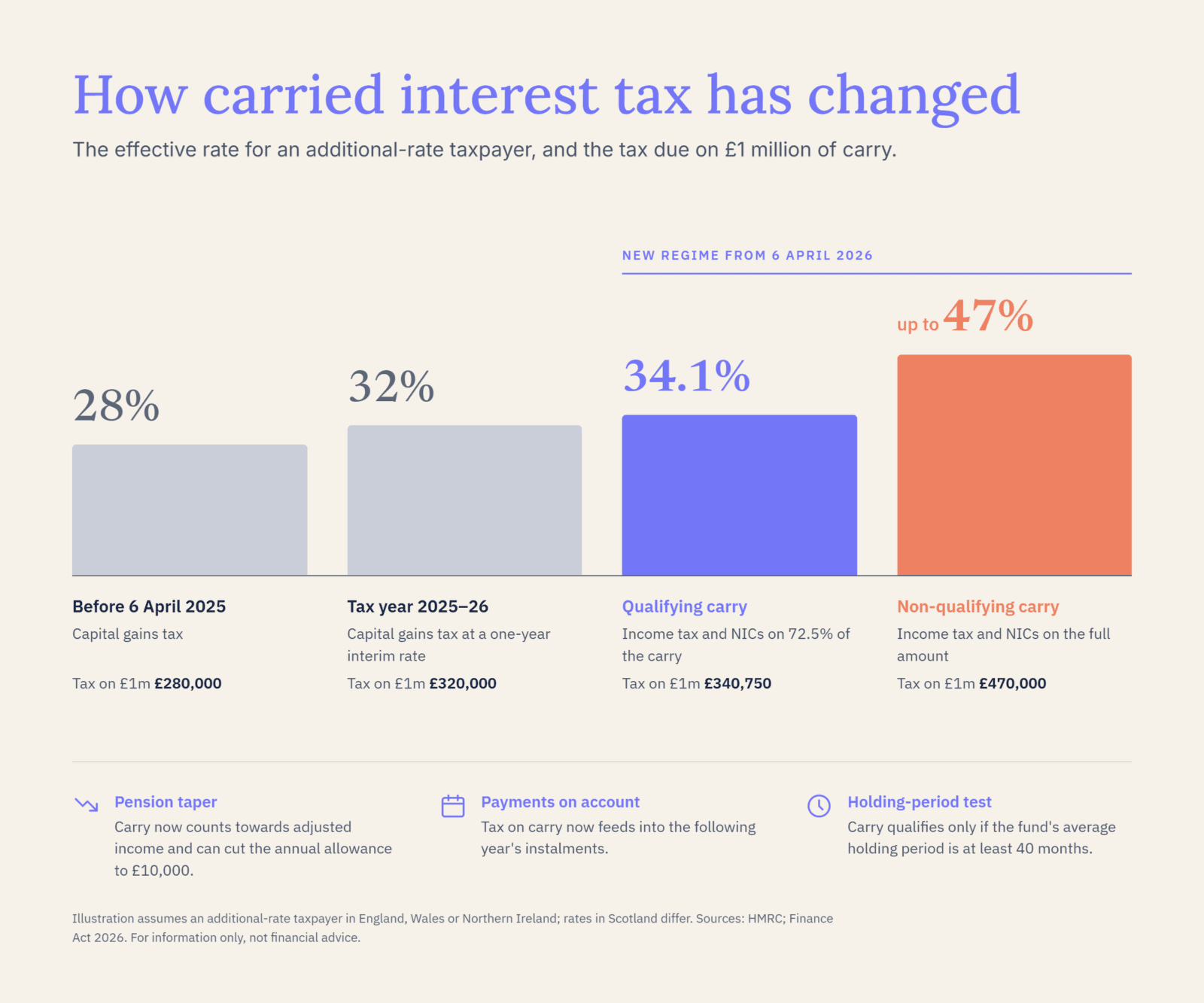
Carry is now income: qualifying carried interest bears an effective rate of about 34.1%; carry that fails the holding-period test can face up to 47%.
Tax bills arrive sooner: carry now feeds into payments on account, so a strong year raises the following year’s instalments.
Pensions need watching: carry counts towards adjusted income, and a late distribution can cut the annual allowance to £10,000.
Co-invest is still capital: genuine co-investment is taxed at capital gains rates of up to 24%, but concentrates risk.
Estates need a fresh look: unused pensions enter the estate for inheritance tax from April 2027.
Mobility cuts both ways: UK workdays can bring carry into charge after emigration, and inheritance tax has a long tail.
Introduction
Few careers reward patience as handsomely as private equity. A partner may spend the better part of a decade nursing a portfolio of companies towards exit, and the pay-off, when it comes, can arrive in a single distribution that dwarfs years of salary. Yet the very qualities that make carried interest and co-investment so valuable — their size, their unpredictability and their long gestation — also make them unusually awkward to plan around.
That task has become more demanding. Many of our clients are working for funds with slower liquidity cycles. Since 6 April 2026 carried interest has been taxed not as a capital gain but as the profit of a deemed trade.¹ ² Pensions and inheritance tax are shifting too, and John Healey’s first Budget as Chancellor, due on 28 October, may bring further change to capital gains tax.³ What follows sets out the planning questions that matter most for those whose wealth is built on carry and co-invest.
Carried interest: from capital to income
Carried interest arising on or after 6 April 2026 is treated as trading profit, subject to income tax and Class 4 national insurance.¹ ² Where carry is “qualifying”, only 72.5% of it is brought into charge, giving an effective rate of 34.075% for an additional-rate taxpayer — not far from the 32% capital gains rate that applied in 2025-26.²
Qualification turns on the fund’s weighted average holding period. Carry linked to investments held for 40 months or more qualifies in full, relief tapers between 36 and 40 months, and below that the rate climbs towards 47%.⁴ Earlier proposals to require a minimum co-investment, or a minimum period between award and payment, were dropped.²
The practical consequence is that the tax cost of carry now depends partly on deal timing that partners may not control. A quick sale that flatters returns can shorten the average holding period and forfeit the multiplier. Planning therefore starts with better information: fund-level projections of holding periods, and a realistic view of when distributions will land.
Co-investment: capital at risk, taxed as capital
Co-investment sits on the other side of the line. Where a partner puts genuine capital at risk alongside the fund’s investors, the returns fall outside the carried interest rules.⁴ Gains are taxed at capital gains rates of 18% or 24%, against an annual exempt amount of just £3,000.⁵
The tax treatment is benign; the concentration is not. Salary, bonus, carry and co-invest all rise and fall with the same firm, and often the same vintage and sector. Where co-invest is funded by firm-arranged loans, gearing magnifies the exposure. A sound plan measures total economic exposure to the manager and balances it with liquid, diversified assets held elsewhere.
Structure matters too. Interests acquired through employment can give rise to income tax if bought at an undervalue, and elections made at the point of acquisition can be decisive. With capital gains tax openly discussed as a Budget target, the timing of any voluntary disposals deserves particular care this autumn.³
Liquidity: planning for lumpy wealth
Private equity wealth is illiquid by design. Commitments are drawn over years, carry may arrive a decade after a fund closes, and distributions can be delayed by escrow, clawback and a sluggish exit market. Household obligations — school fees, mortgages, tax — are rather more regular.
The new regime adds a specific pressure. Because carry is now income, the tax on it counts towards the following year’s payments on account.² A strong carry year can therefore bring a large bill the next January and July, even if nothing further arrives. Payments can be reduced, but underestimating them invites interest charges.⁴
The remedy is a deliberate liquidity reserve, sized to cover known capital calls, tax liabilities and several years of spending, and held in low-risk assets. Clawback exposure deserves its own provision: a partner who spends or reinvests every distribution may later have to return part of it.
Pensions: a smaller allowance and a new estate rule
Carry’s move into income tax has an awkward consequence for pensions. Under the capital gains regime it did not count towards adjusted income for the tapered annual allowance; it now does.⁴ Above £260,000 of adjusted income, the £60,000 allowance falls by £1 for every £2, to a floor of £10,000.
Timing is the difficulty. RSM illustrates a partner on £250,000 who contributes £22,500 over the year and then receives £150,000 of carry in March. The allowance collapses to £10,000, and the excess triggers a £5,625 charge that must be paid in cash.⁴ Contributions are best reviewed as distributions become visible, with unused allowances from earlier years checked in advance.
The pension’s place in estate planning is changing as well. From 6 April 2027, most unused pension funds and death benefits will count towards the estate for inheritance tax.⁶ The familiar strategy of spending other assets first and leaving the pension untouched now needs re-examining.
Estate planning: passing on carry and co-invest
Carry has long been among the most effective assets to pass down. At a fund’s launch its market value is often modest; if the fund performs, the growth accrues outside the donor’s estate. Gifts to individuals fall out of inheritance tax after seven years, while gifts into trust above the £325,000 nil-rate band are taxed immediately — an argument for acting early, while values are low.
Two cautions apply. The income tax charge generally stays with the executive: carry routed to trusts or connected persons is still taxed on the individual when it arises.⁴ A gift can therefore shift value for inheritance tax while leaving the donor with the income tax bill. Valuations must also be defensible, and fund documents often restrict transfers.
Co-invest is simpler to pass on, though a gift counts as a disposal at market value for capital gains tax. Trusts and family investment companies both have a role, but neither is a substitute for a clear view of what the family actually needs.
Residence and mobility: counting the days
Many partners will live in more than one country over a career. The new regime taxes non-residents on carry to the extent that it relates to investment management services performed in the UK, measured by a strict workday count rather than a “just and reasonable” apportionment.² Workdays before 30 October 2024 are ignored, as are those in years when a non-resident works fewer than 60 days in the UK.² Other countries may still treat carry as a capital gain, raising the risk of double taxation.
Inheritance tax follows its own logic. Since April 2025 it has turned on residence rather than domicile: anyone resident for 10 of the previous 20 tax years is a long-term UK resident, and remains within scope on worldwide assets for three to ten years after leaving.⁷ New arrivals, by contrast, may claim a four-year relief on foreign income and gains.⁵
For anyone contemplating a move, a contemporaneous diary of workdays is the cheapest insurance available.
A financial plan that's longer than the fund
Private equity rewards those who think in decades, and personal finances deserve the same discipline. Carry and co-invest are no longer simply capital to be taxed on exit; they now touch income tax, cash flow, pensions and the estate in ways that shift from year to year. A plan built around a single distribution is likely to disappoint. One built around the fund cycle — revisited as each vintage matures, and again after the Budget on 28 October — stands a far better chance.
This article is for general information only and is not financial, tax or legal advice. Figures reflect the rules in force on 28 September 2026 and may change.


Sources & Notes
Deloitte, Changes to the UK carried interest regime, UK Tax Policy Map, updated 8 September 2026.
Saffery, Autumn Budget 2026: expected UK tax changes, 28 September 2026.
HMRC, Capital Gains Tax rates and allowances, updated 13 April 2026.
HMRC, Inheritance Tax on pensions: technical note, updated 29 May 2026.